

As the church moves through Holy Week and toward the glorious resurrection of Christ on Easter, we reflect on Christ’s sacrifice for our sins. Read this excerpt from Luther’s Works, Volume 63 (Exodus 20–34 and Prophets), which showcases Martin Luther’s insights into Christ’s death and resurrection and how He forgives our sins.
Christ Bearing Our Sins and Interceding with the Father
And the Lord has placed in Him the iniquities of us all, etc. [Isaiah 53:6]
Here the prophet goes on to explain the fruit of the suffering of God’s Son, our Lord and Savior Jesus Christ. However, the term “all” should not only be understood in a collective sense, as if it would mean that only some did not go astray, but in a distributive sense: each for himself, separately, each one. For the prophet excludes none except those who are in Christ. “And the Lord,” he says, “made the sins of us all come together to Him.” The verb for “come together,” which in Hebrew is paga, properly means “overwhelm” or “to intercede,” as, for example, Abraham did with Ephron in Genesis 23 [:8].
Likewise, Christ both bore our sins and interceded for us with His Father, and He actually became, as Paul says, “a curse for us, to redeem us from the curse of the Law” [Gal. 3:13–14]. To express this with all the more emphasis, the prophet used this particular verb paga, which properly means both “to come together” and “to intercede.” And the Chaldean translation explains this text even more clearly by translating it as follows: “It was pleasing to the Lord to forgive us all sins because of Him.”
Christ’s Sacrifice Forgives Us of Our Sins
So this Christ, the Son of God and Son of the Virgin Mary, is the one person who took our sins, diverted to Himself the wrath of God because of our sins, and intervened for us with His Father. Because of Him, the Father forgives us of our sins and gives us the Holy Spirit and eternal life. Let us, therefore, take refuge in Him and hold it as a certainty that the Father has been reconciled to us through Him. For whosoever believes in Him is completely free from sins and has eternal life, as John 1 [:29] says, “Behold, the Lamb of God, who takes away the sins of the world.” Likewise: “To all who believe in His name, He has given the power to become children of God” [John 1:12]. Likewise, John 3 [:16]: “God thus loved the world, that He gave His only-begotten Son, that everyone who believes in Him should not perish but have eternal life.” Likewise: “For God did not send His Son into the world to judge the world, but that the world through Him might be saved” [John 3:17]. Therefore, sin cannot harm the believer. Since He has borne all the sins of the entire world, there is absolutely no sin left that He has not borne, overcome, and destroyed—unless by my unbelief I do not want them to be taken from me and destroyed for me. So it says in John 16 [:8]: “The Holy Spirit will accuse the world of sin.”
Your Sins Are Forgiven Only Through Belief in Christ
The Lord made the sins of all of us to rush upon Him; moreover, sin is not believing in Him. The Jews and all hypocrites want to be righteous by the Law. But the Gospel teaches that unless faith in Christ is present, you still remain under sin and the wrath of God [John 3:36]. And this is true even if you had the full righteousness of the Law, which is impossible. If you do not believe in Him upon whom all the sins of the entire world have rushed, you have no life (John 3 [:36]): “He who does not believe in Him will not have life, and God’s wrath will remain on him.” God appointed Him to bear the attack of Satan, death, the Law, and to bear the sins of the entire world and all people. Sin killed Him, but He is someone who cannot be killed. He was killed according to the birth of flesh, and yet it is said rightly that God’s Son was killed. He could not be killed because of that sting in the Gospel, that He is the living God, as He says, “I live, and you will live” [John 14:19]. “Although I die for you, yet even as I die, I will live, because I am God and man. Death can bite Me and kill Me, but it cannot hold Me in death.”
So we have in Him the Bishop of our souls [1 Pet. 2:25], who has freed us from death and all the dangers of death and has given us peace and healing through His bruise.
The Lord Showed No Suffering or Want of Retribution
But what was the Lord thinking about when He suffered for us? Was He perhaps thinking of retribution and revenge toward the Jews who crucified Him? No, but (as the prophet says) “when He was humbled, He did not open His mouth; He was like a sheep that is led to the slaughter” [Isa. 53:7]. For when a sheep is dragged to the slaughter, and also when it is sheared, it does not open its mouth or utter a sound by which it would show its suffering. So it was with our Peacemaker, Savior, Healer, the Arm of the Lord, the only-begotten of God. What did He do when He was being punished and severely wounded? He did not open His mouth or mutter a sound. Hence Peter says, “When He was suffering, He did not threaten, He did not curse” [1 Pet. 2:23].
Peter explains this faithfully through the Holy Spirit. Here we have the utmost patience and innocence. Not even with a word does He show any desire to take revenge on His enemies. For His thinking was about peace and salvation and about healing our sins through His wounds. He did not think about wrath or the ruin of those who were crucifying Him. His thoughts were about freeing us.
Blog post adapted from Luther’s Works, American Edition, vol. 63 © 2024 Concordia Publishing House. All rights reserved.
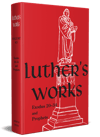 Read more of Martin Luther’s teachings and insights by ordering Luther’s Works, Volume 63.


