A better term for “Lutheran” spirituality is “evangelical” spirituality. The term evangelical is simply a term derived from the Greek word for “Gospel,” which in turn literally means “good news.” To be “evangelical” means focusing on the Gospel of Jesus Christ, the Good News that Christ, through His death and resurrection, has won forgiveness for sinful human beings and offers salvation as a free gift.
This profound statement is from Dr. Gene Edward Veith’s book The Spirituality of the Cross. After reading this book, I’ve collected some of my own reflections on this best-selling work. Come along as we trace Christian spirituality outside of ourselves and to the cross of Jesus Christ.
The Cross of Jesus as the Eternal Foundation
Dr. Veith leads us back to what is both foundational and eternal: the cross of Jesus Christ. This blessed truth, which informs and runs through every aspect of Christianity, must be the North Star of all that Christians preach, teach, and confess. The author presents the Lutheran distinctiveness of the centrality of the cross through seven treatments of the Christian faith, most notably justification, Christology, and the concluding chapter on worshiping God.
Veith writes,
Instead of insisting that human beings attain perfection, Lutheran spirituality begins by facing up to imperfection.
To be Lutheran is to be biblical, and the Bible teaches that since the fall, humanity is not merely damaged but destroyed. Consequently, God’s goal is not to encourage men to fix themselves but rather to re-create us from the ground up. Recognizing and confessing this reality is contrary to much of Protestantism, which teaches that human beings still possess a degree of the righteousness with which God imbued us at creation—that sinners can want to know, and to love, and to choose the one true God. God’s Word informs us of quite the opposite. We are conceived spiritually blind. Dead. Enemies of God. Without the work of the Holy Spirit, we cannot choose, love, or even want to know the true God. He must remedy our sorry state at His own expense. He chooses us.
Relatedly, Veith writes,
The spiritual life has to do with recognizing God’s work—what He accomplished on the cross and what He continues to accomplish in our lives.
This notion is frustratingly contrary to our nature. Even as Christians, our nature wants to do something, to play some part. There are two salient reasons for this. First, playing a part in our own spirituality would provide a sense of control. One might think if we have something to do with it, we can be sure it won’t fail. This feverish desire for control comes from a lack of faith in God. Second, taking part in one’s spirituality soothes the tender ego. If God is categorically responsible, when do I get credit? The reality is beautiful but can be challenging to accept. Growing spiritually means having a fuller understanding and appreciation for what God has done. Even this understanding and appreciation come from God.
Christ Who Took on Human Flesh
As Veith stresses the centrality of the cross, he discusses the importance of a proper understanding of Christology (in other words, who is Christ?). He writes,
Luther stressed that the reason God became incarnate in Christ is that is the only way that we radically limited mortals can know Him. We dare not presume to come to conclusions about God and His disposition toward us except through Jesus Christ.
This makes sense. Imagine drawing such conclusions merely from creation. One might argue that nature proves God is beautiful: Parents are loving toward their children; enemies forgive one another. Yet what would we make of animals eating each other, murder, war, natural disasters, injustice, and the like? God would seem indeed terrifying. With Christ, we see humanity as God intended, the grace of God, and God’s overwhelming love for His creation.
Recognizing Christ as fully both God and man has applications for the Christian life. Veith notes,
Christ is present in the Sacrament by virtue of the Word of God—the Words of Institution, the Word made flesh, the Word of the Gospel—here presented in bread and wine.
Christ, the Son of God, took on human flesh, in part so that in the Lord’s Supper, we could receive Him and thereby the benefits of what He has done on the cross. Christ tells us that the bread is His body and the wine His blood, joining Himself to these visible elements that we might consume Him. A second reason Christ took on human flesh is the very sacrifice on the cross itself. There are two ways we as Lutherans understand how God fixed humanity’s sinful predicament at His own expense. First, since it was a human being who brought sin into the world, another human being would have to live a life without sin. This is Jesus Christ. In taking our human flesh, Jesus lived the life we needed to live in our place. Second, to pay for our sins, a human being would have to suffer and die. Jesus, fully human, did this for us.
Receiving Christ in Worship
Veith further elucidates the centrality of Christ in his treatment of worship:
The main order of worship that Lutherans follow is called the “Divine Service.” It is called that not because in worship we are serving “the Divine,” but because in worship “the Divine” is serving us.
This follows: Because God is the doer in our salvation, it makes sense that He would be so in worship as well.
When we stress how we worship and praise God, we place the emphasis on ourselves and give ourselves the credit for what is being done. In truth, however, the highest form of worship is to receive God’s gifts. Specifically, to hear His Word in the readings, hymns, and sermon; to receive His true body and blood in the Lord’s Supper; and to receive His Spirit in Holy Baptism.
There is so much more to Veith’s book, but this brief reflection represents the fine work Dr. Veith has done in drawing the reader back to the center—Jesus Christ. The reader is led away from finding security and meaning in his own meager efforts, done with broken motives, and instead led toward the cross: God acting to reconcile sinners to Himself, and at His own expense.
Quotations taken from The Spirituality of the Cross, third edition © 2021 Concordia Publishing House. All rights reserved.
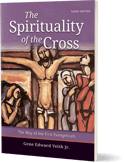 Continue exploring the spiritual tradition of Lutheranism in the third edition of The Spirituality of the Cross.