

From Texas to Wisconsin to California, I’ve gotten calls from churches and other ministries looking for answers about governance. That’s just this week, and it’s only Wednesday. Maybe it’s because I’m a Governance Systems Professional or maybe it’s because of my book, Principles for Good Order, but the voices of those looking for a better model of governance for their church council or camp board or district board are becoming louder and more numerous.
Boards Are Critical
Let’s face it—boards play a critical role in the success … or failure … of our ministries. I’ve been dumbfounded for decades at the nonsensical behavior of boards that are, by and large, populated with wonderful, well-meaning, faithful people. I’m convinced these folks don’t mean to inflict the harm on ministry that they so often do. So, why do they do it?
I would suggest that most of us have no real idea about the role of a board within a ministry. Add to that the confusion of multiple boards (education board, missions board, youth board, worship board, trustees board, elders board) still found in so many of our churches, and it makes it all the more confusing. Sitting on a board feels important. It causes people to think they must do something to move ministry forward. “Doing” almost always translates as getting involved in day-to-day operations. And boards that attempt to manage day-to-day operations are doomed to ongoing failure and frustration. Not to mention meetings that last into the wee hours of the morning.
Principles Based Governance
There’s a better way. Principles Based Governance is built on the ten principles first articulated by John Carver in 1990 when he introduced his Policy Governance® model to the world. While Carver’s work, over time, caused people to fixate on the policies that were written, it is the principles that are the bedrock foundation of the model and key to its success. When a governing board focuses on policies, they tend to co-mingle governance and operational policies. We find boards that write the personnel handbook, which is clearly operational and not governance. “But they are personnel policies; therefore, a policy board should be writing those policies.” No!
The church that chooses to build its governance on the ten principles has chosen wisely. You see, when you remain faithful to the principles, you can write policies that provide transparency, clear lines of authority, and accountability, leading to a culture of trust and operational excellence. When you focus on the principles, policies take their proper place and are rightly treated as adaptable, reviewable, and able to be changed to provide maximum ministry effectiveness. Too often I’ve seen ministries so bound to their policies that it became priority No. 1 to serve those policies at the expense of ministry. Principles Based Governance relieves the stress of what I’ll call overweening fealty to policies.
Here, in short, are John Carver’s ten principles tuned to Lutheran churches. I elaborate further on these in my book, Principles for Good Order: Creating Organizational Harmony Through Effective Governance for a complete exploration of Principles Based Governance.
Ten Principles for Good Order
-
The board is the servant-leader of the voters’ assembly and derives its authority from them.
-
The board occupies the space between the voters and operations, navigating the ministry through the delegation of operational authority on behalf of the voters to the pastor.
-
The authority of the board is corporate and singular. No individual authority is granted to board members. Therefore, authoritative decisions of the board are only made as a total group.
-
The board defines in writing why the church exists, who benefits from its existence, and what benefits those beneficiaries receive.
-
The board defines in writing its process of governing and its delegation of operational authority to the pastor.
-
The board sets in writing the operational boundaries around the pastor proscriptively. That is, they define what he cannot do to accomplish the purpose of the ministry rather than detailing all the many things he must do.
-
The board sets all policies at the broadest, most inclusive level and only goes into further detail if necessary to mitigate risk and/or narrow the interpretive range of the pastor in making operational decisions.
-
The board has only one direct report and honors the delegation of authority to the pastor by working only and directly with him.
-
In delegating all operational authority to the pastor, the board grants him the right to use any reasonable interpretation of the policies when making operational decisions.
-
Any evaluation of operational leadership is solely based on the accomplishment of the ministry’s purpose while staying within the limitations set by the board.
Blog post adapted from Principles for Good Order: Creating Organizational Harmony Through Effective Governance
© 2026 Tim Kurth, published by Concordia Publishing House. All rights reserved.
Policy Governance® is the invention of Dr. John Carver and an internationally registered trademark of The Governance Coach Inc.
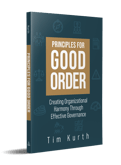 Want to learn how these principles work in practice? Principles for Good Order provides the theological grounding, real-world examples, and leadership wisdom behind each one.


